For teachers, parents, and curious learners of every age
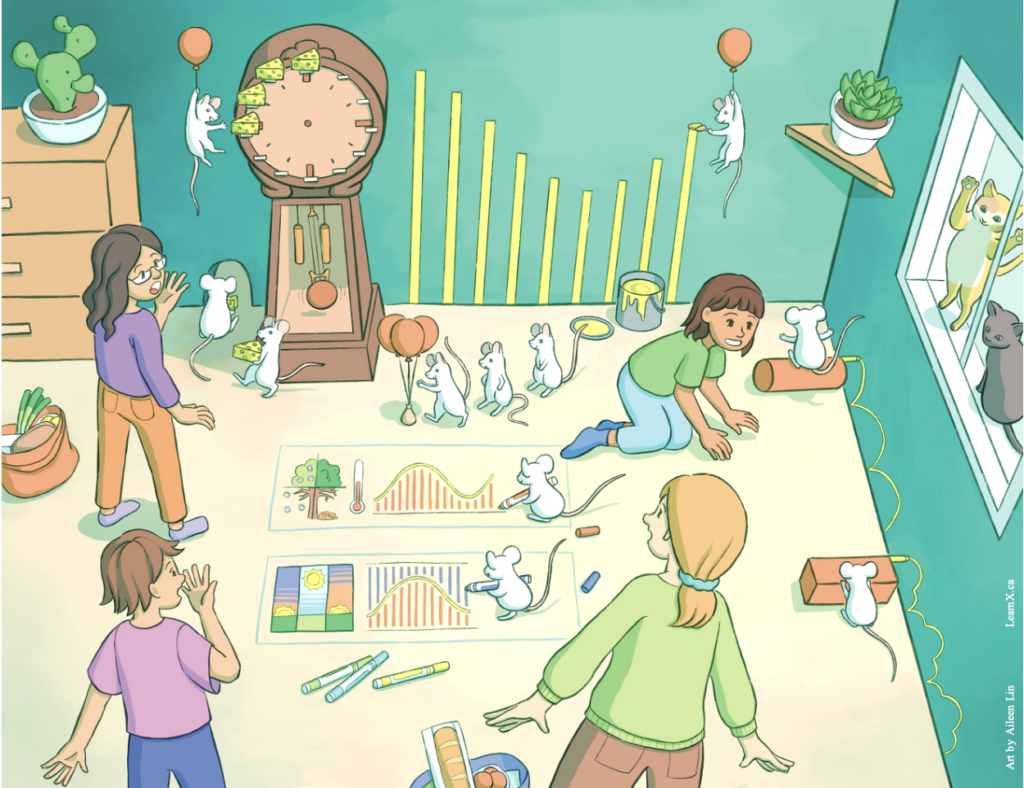
Let’s be honest: most of us know some math, maybe even a respectable amount, but often we’re just skimming the surface, with very little understanding.
This resource peels back the curtain on everyday mathematics, revealing a surprising, interconnected world that lies beneath, in ways that are understandable and easy to communicate to others.
Take a look through it. Have fun with it. And share it with someone who enjoys a good “wait… what?” moment as much as you do.
The wonder of it all
As you read these words, the planet beneath your feet is racing around the Sun at nearly 100,000 km/h, carrying you along without so much as a wobble in your coffee cup. And our Sun, our entire solar system, is itself sweeping around the center of the Milky Way at an astonishing 850,000 km/h, taking about 230 million years to complete a single cosmic lap. All the while, the Milky Way is drifting through the vast dark at something like 1.5 million km/h.
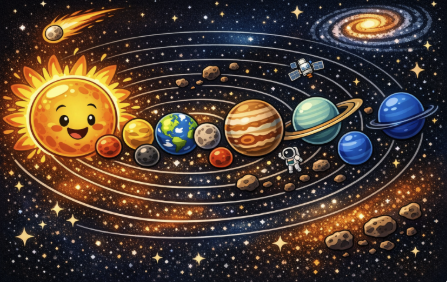
And despite the cold and emptiness out there (roughly –270°C) we live warm, busy, incredible lives inside a thin atmospheric cocoon that protects us so completely we hardly notice it’s there.
Inside this shelter, across thousands of years of curiosity, imagination, and the natural human need to understand, we’ve created mathematics of breathtaking depth and elegance. The kind of mathematics that lets us land on the Moon. The kind that powers artificial intelligence systems. The kind that helps us model galaxies, predict weather, design vaccines, and send signals across oceans and into space.
Yet somehow, amid all this wonder, we often give young children, our future explorers and thinkers, mathematics that is tiny, flattened, and sometimes just plain wrong.
We teach children to calculate surface area and volume of cylinders, cones and cubes…
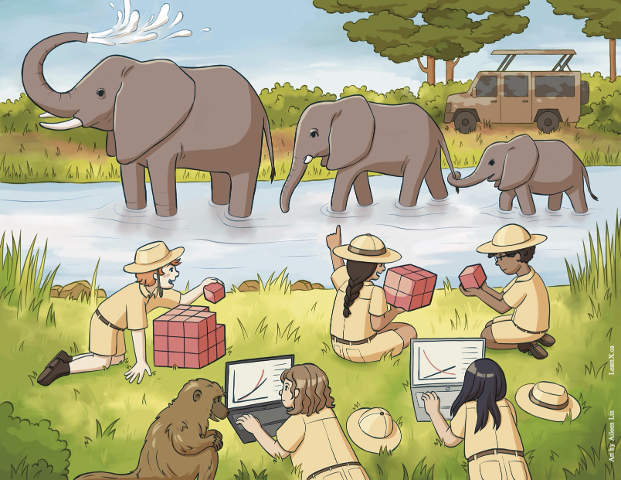
But we don’t invite them to ponder: why elephants have big ears
and what unexpected connection might mathematics have to that question?
We tell children, “Parallel lines never meet”
without giving them the chance to discover that on a sphere, on the very planet they stand on, those lines curve, embrace, and eventually cross.
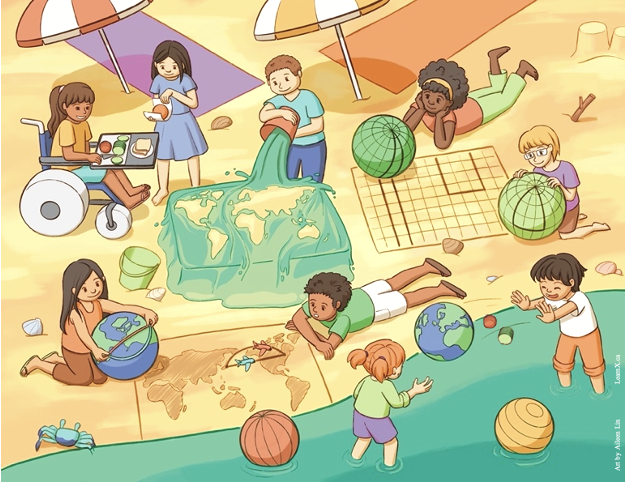
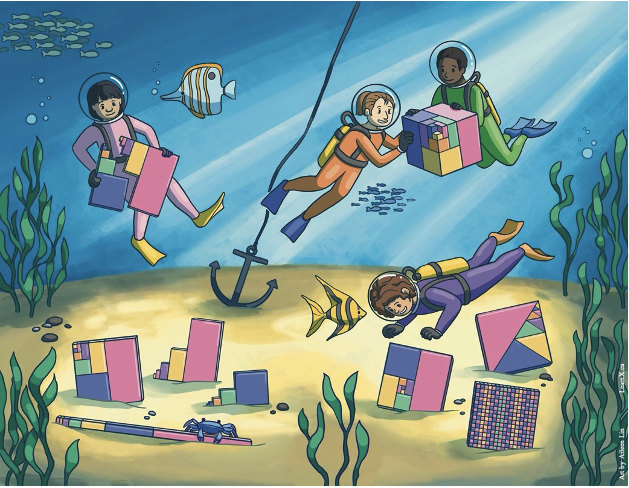
We tell them, “You can’t hold infinity in your hand”
instead of engaging them to imagine all the clever, playful ways they actually can.
We often flatten mathematics, pressing all its colour and life out of it, until it becomes something forgettable.
But that is not what mathematics truly is.
Mathematics holds surprises hiding in plain sight, and ideas that reveal themselves when children are given the chance to investigate and understand. When they can make connections across concepts, notice relationships, and follow their curiosity, math stops being a list of individual things to learn and becomes a wide landscape, rich, and full of wonder.
Understanding in depth
Mathematics reveals its beauty when we explore it deeply.
For this to happen, teachers and parents play a vital role. When we develop strong, connected understandings of mathematical ideas, we see how concepts relate, grow, and build on one another, and we create the conditions for children to experience mathematics as an exciting journey.
This resource is an invitation to begin that journey.
It offers starting points, insights, and explorations designed to spark curiosity, strengthen understanding, and open doors to the deeper side of mathematics.
You don’t have to learn everything at once. Start with a favourite deep activity. Occasional, well-designed mathematics experiences can have lasting impact, raising expectation and anticipation of what mathematics can offer.
A historical problem
Our struggle with developing mathematical understanding is not new.
It is a long‑standing, widespread pattern that spans cultures, continents, and centuries.
We have good intentions.
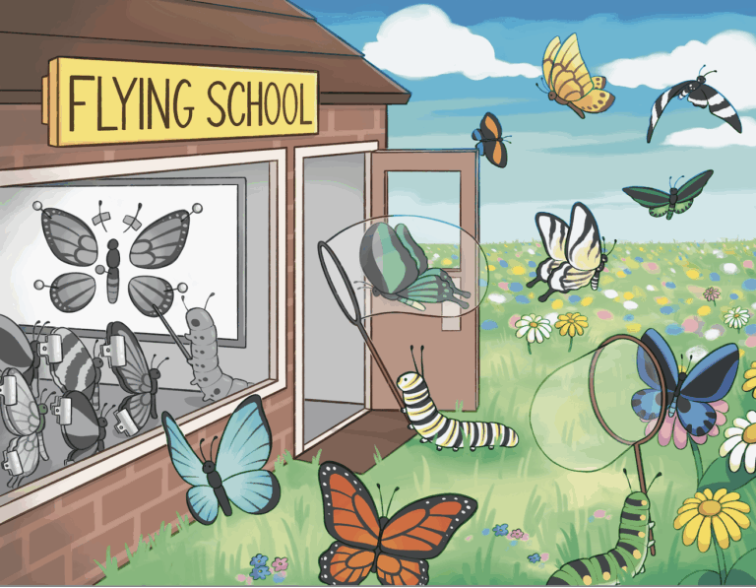
But without recognizing the importance of deep mathematical insight, we often find ourselves in an impossible position. It’s as if we are caterpillars who know only the surface of leaves and branches, doing our best to teach butterflies how to fly.
We care.
We try.
But without mathematical depth, our efforts do not take flight.