Infinity in your hand?
Can you hold infinity in your hand?
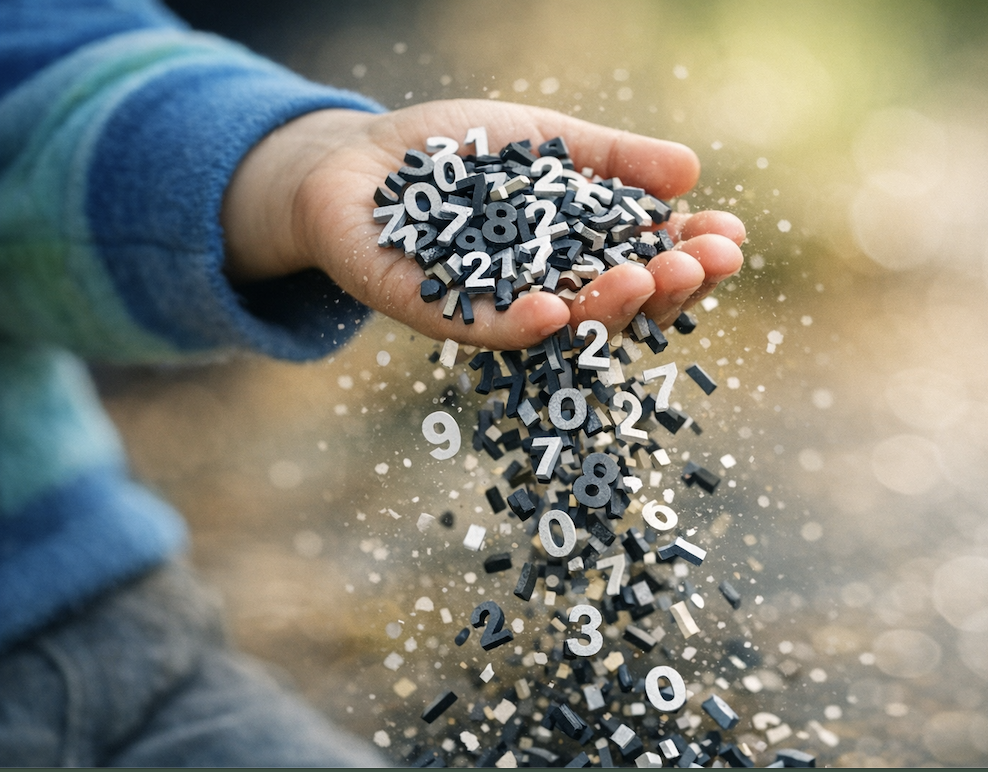
Most students answer: “No,” or, “You could try, but it would spill over.”
Let’s see where this question may lead us next.
Calculus
When I taught Calculus, I liked to start with a puzzle. Before we talked about limits or infinity, I’d ask my students to imagine this: Start walking toward the door. Go halfway. Then go halfway again. Then halfway again. Keep halving forever. So… do you ever reach the door, or are you stuck in the classroom for eternity?

Students rarely agreed, which made conversations wonderful. Some insisted you’d eventually get there. Others were convinced you’d be stuck in an endless “almost‑but‑not‑quite” loop. What do you think?
Infinity has been confusing and entertaining mathematicians for thousands of years. Zeno certainly had fun with it. In one of his famous paradoxes, he gives a turtle a head start in a race against a rabbit. According to Zeno, the rabbit can never catch up.

Every time the rabbit reaches the spot where the turtle was, the turtle has already shuffled a little farther ahead. This keeps happening forever. Just like your steps toward the door, the gap shrinks and shrinks but never quite disappears… or does it?
Grade 3
While co‑teaching in Grade 3 classrooms, teachers asked: “Any fun ideas for teaching fractions with area models?” Hmm… what if we use the fractions from our ‘walk to the door’ adventure?
So off we went, shading area representations of 1/2, 1/4, 1/8, and so on.

Out came the scissors. Students snipped out the shaded pieces, creating little islands of fractions floating on desks.

Then came the twist. We asked them to rearrange all those fractional bits to build a brand‑new shape. When they finally pieced everything together, their eyes widened: every single shaded piece fit perfectly into one square!

Once they got the hang of it, the creativity exploded. Students shaded their fractions in colourful patterns and proudly turned them into math art.
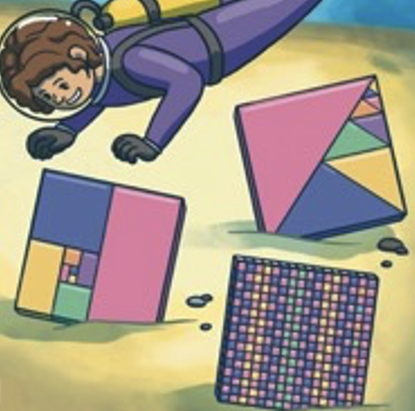
The best part? They marched home to share their creations and announcing with their parents, “Look! I can hold infinity in my hand!” Not a bad day’s work for Grade 3 mathematicians.
Through the eyes of a mathematician

Dr. Graham Denham from Western University took this little fraction adventure for a spin.
He spotted something the rest of us had completely missed: some of the shaded bits were perfect little squares… and some were definitely not. Naturally, he rearranged everything, until the two types of shapes stood out clearly.

Then he paused and asked: “Hmm… what fraction of the whole square is made up of the square‑shaped pieces?”
A wonderful new puzzle was born.
What do you think the answer might be?
Take a peek at this video clip to see Dr. Denham puzzle it out in real time.
| Interview with Dr. Graham Denham (Western University) |
Infinity in a song
Every now and then, math sneaks into places you’d never expect, like, say, a classic Cat Stevens tune.
| MATH SHADOW. A parody of Cat Stevens’ Moonshadow. Lyrics by George Gadanidis. Music and performance by Ian Parliament. |
Infinity and probability
Infinity and probability: A curious story
Imagine a box.
Not an ordinary box, but a magical one. One big enough, somehow, to hold all the Natural numbers. Every counting number you’ve ever known is inside: 1, 2, 3, 4… and continuing right on toward infinity.

Now picture yourself reaching in blindly.
You cup your hand around one of them and pull it out.
What’s the probability that it’s odd?
Most people answer quickly:
Half.
Fifty percent.
That feels right. Odd, even, odd, even. For every even number, there’s an odd partner. So yes, half the numbers in the infinite box are odd, and half are even.

So far, so sensible.
But then you try a different question:
What’s the probability that the number you pick is 7?
Thinking about the first 10 numbers, the chance is 1 in 10.
In the first 100, it’s 1 in 100.
In the first thousand, it’s 1 in 1,000.
The more numbers you include, the smaller the probability becomes. It shrinks the way your steps shrink when you walk toward a door but always move only half the remaining distance.
And so, in the infinite box, the probability of picking 7 isn’t just small.
It’s zero.
Now the story deepens.
What about the probability of picking a square number?

Squares sparkle here and there inside the box:
1² = 1, 2² = 4, 3² = 9, 4² = 16, 5² = 25 …
They stretch on forever, getting farther and farther apart as the numbers grow. There are infinitely many of them, yet they become increasingly rare.
What, then, is the probability that your hand lands on a square number?
Share
Share this puzzle with a friend.
Argue about it.
Wonder about it.
Infinity is full of surprises.
Probability becomes slippery.
In the world of infinity and probability, the questions are often simple…
and the answers are wonderfully intriguing.