Where do odd numbers hide?
Let’s begin with a simple, playful question:
“Where do odd numbers hide?”
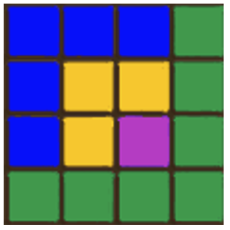
Young children may work building odd numbers using link cubes, alternating colours to form L patterns…1 cube, then 3, then 5, and so on. Soon the tables are covered with bright, striped L towers of odd-number models.

Then something magical happens.
Using nothing but their eyes and their sense of pattern, children start arranging the models to fit like spoons. As the shapes click together, they notice a surprising fit.
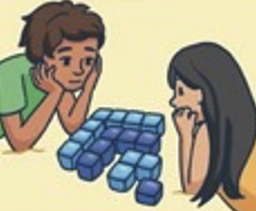
The odd numbers form perfect squares.

“Odd numbers hide in squares!” a few children exclaim, wide‑eyed.
They explore this discovery further:
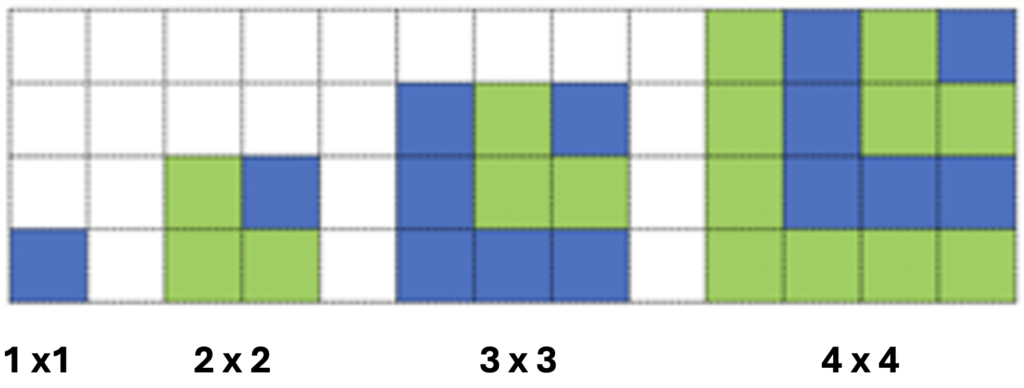
- The first odd number makes a 1 × 1 square.
- The first two odd numbers make a 2 × 2 square.
- The first three odd numbers make a 3 × 3 square.
- The first four odd numbers make a 4 × 4 square.
- The first five odd numbers make a 5 × 5 square.
- The first ten make a 10 × 10 square.
The pattern is astonishingly simple, yet beautifully powerful.
Let’s count the total number of blocks:
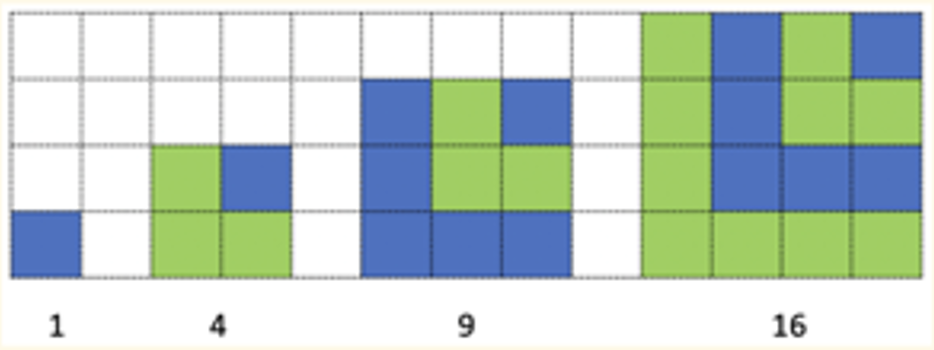
- The first odd number needs 1 block.
- The first two need 4 blocks.
- The first three need 9 blocks.
- The first four need 16 blocks.
- The first five need 25 blocks.
- The first ten need 100 blocks.
And so, through touch and sight and play, children rediscover an elegant idea in mathematics:
The sum of the first n odd numbers is n².
Where Do Even Numbers Hide?
Naturally, someone asks,
“If odd numbers hide in squares… where do even numbers hide?”
This question launches a new wave of building, arranging, testing, and noticing. Another journey of mathematical discovery.

Where Do Natural Numbers Hide?
Children built two identical sets of the first four natural numbers.

They experiment with combining these sets and discover that they may be arranged to form the exact shapes made by the first four even numbers.
In their hands, the natural numbers revealed a secret structure.
Math Art (or “Mart”)
Children rearrange number models into patterns, pictures, and playful designs.
Mathematical structure becomes artistic structure.
The classroom fills with joyful “m-art”.
As they travel through grades
These same physical models can be used to derive algebraic formulas for the sums of odd, even, and natural numbers.
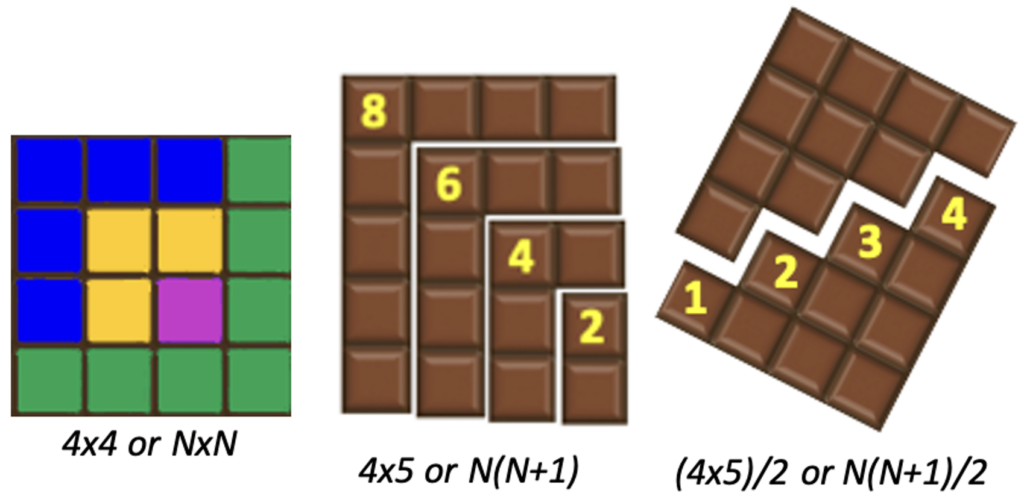
These models become bridges across arithmetic, geometry, and algebra.
A Surprise in High School
We teach these concepts in grade 11.

What else might be possible if students across the grades are engaged in seeing and understanding mathematics in such powerful and accessible ways?
Seeing-As
The Canadian poet‑philosopher Jan Zwicky writes that metaphors and representations invite us to “look at things like this.”
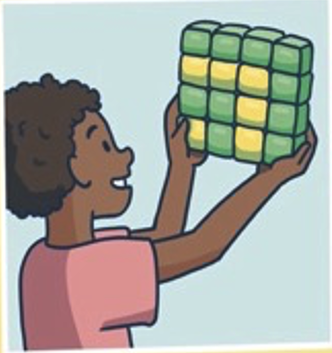
These classroom models do exactly that.
They become tools for seeing-as…
seeing number as shape,
seeing pattern as structure,
seeing mathematics as something you can hold, build, manipulate, and understand.
They turn ideas into objects to think with, and into insights.
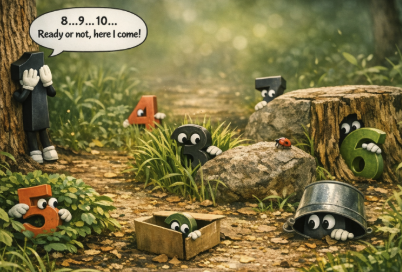
So, where do numbers hide when they play hide and seek?
Well… numbers aren’t exactly subtle.
They think they are, but they’re about as sneaky as a giraffe in sunglasses.
Odd numbers are convinced they’re invisible if they stand inside perfect squares.
You can still see them peeking out of the corners, counting themselves over and over:
“1, 3, 5… shh!! Don’t give us away!”
Even numbers prefer rectangles, with “more elbow room”.
And natural numbers?
Oh, they’re mischievous!
They hide inside the even numbers, who find this extremely annoying.
What do you see?
How many odd numbers are hiding in the blue square?

Odds are tricky
It started during a math‑for‑teachers course that the group eventually nicknamed the math therapy course.
In one of the sessions, what began as a routine investigation of odd an even numbers turned into a moment of clarity—one of those small mathematical awakenings that makes everyone sit back and say, “Wait… why didn’t anyone show it to me like this before?”
The lyrics in the song below are based on the teachers’ comments—collected, treasured, and performed through song and animation, as evidence of their journey through the puzzling, delightful world of odd and even numbers.
| ODDS and EVENS. A song based on comments in a math-for-teachers course. Lyrics by George Gadanidis. Music and performance by Ian Parliament and Ryan Casselman. |