“One geometry cannot be more true than another; it can only be more convenient.”
―Henri Poincare
Parallel lines can meet?

A riddle
Pose this riddle to your students:
Molly steps out of her tent. She walks 1 km south and 1 km west. She sees a bear and gets scared.
She runs 1 km north—and arrives back at her tent.
How is this possible? And what colour is the bear?
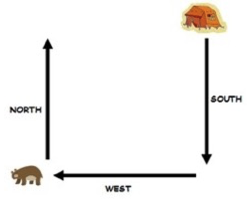
If you’re not sure of the answer, you’re not alone!
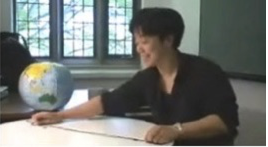
To explore the surprising geometry behind this riddle, and what it reveals about parallel lines on curved surfaces, watch an interview with Dr. Megumi Harada from McMaster University at https://www.fields.utoronto.ca/mathwindows/sphere
Parallel Lines in History
About 2,300 years ago, Euclid attempted to prove his Parallel Lines Postulate… but he never succeeded. Neither did the many mathematicians who tried after him.
It turns out that the statement “parallel lines never meet” is not a theorem to prove. Instead, it is an assumption. And when you change that assumption, you get entirely different geometries.
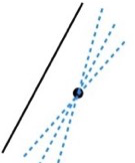
Here is the question at the heart of Euclid’s struggle:
Given a straight line and a point not on that line, how many straight lines can you draw through the point that never intersect the original line?
Euclid believed the answer must be one, but he could not prove it.
Different answers lead to different geometric worlds:
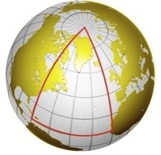
- — If the answer is “1,” we are in Flatland, also known as Euclidean geometry, the geometry most people learn in school.
- — If the answer is “0,” we are on a sphere, where “parallel” lines eventually meet. For example, on a globe, the equator and lines of longitude form “triangles” whose interior angles add up to many different values.
- — If the answer is “infinitely many,” we are on a hyperbolic surface, where space curves outward like a saddle.
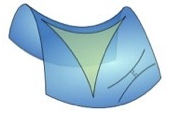
This historical struggle ultimately led to the discovery of non‑Euclidean geometry, one of the major mathematical breakthroughs of the 19th century.
4. Sum of the Angles in a Triangle on a Sphere
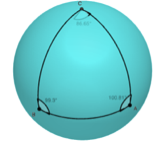
What is the sum of the interior angles of a triangle drawn on a sphere?
On a sphere, the sum of the angles is greater than 180° and less than 540°.
Students can explore this using the GeoGebra interactive simulation:
www.geogebra.org/m/sPx39Zfd
A few important ideas:
- — The edges of the triangle must be straight—meaning they must lie along great circles, the “straightest possible lines” on a sphere.
- — If all three vertices lie just slightly away from a great circle, then each interior angle becomes close to 180°, and their total sum approaches 540° from below.
- — To form a proper triangle, however, each angle must be less than 180°.
- — Therefore, the sum of the interior angles of a spherical triangle must be just above 180° and just below 540°.
Spherical geometry provides rich opportunities for students to connect shape, curvature, and angle measures, and to see how changing a single geometric assumption reshapes the entire mathematical world.
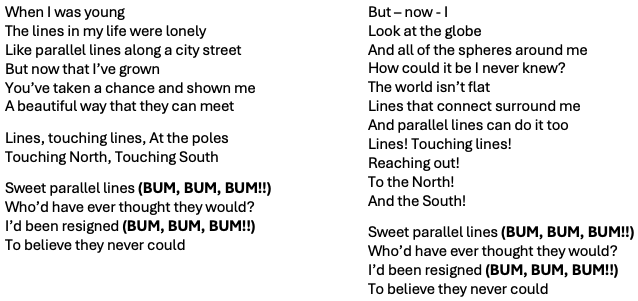
SWEET PARALLEL LINES
Listen to this song about parallel lines, by Victoria Smith.
| Lyrics by Victoria Smith. A parody of Sweet Caroline by Neil Diamond. |
Lyrics