“One person’s constant is another person’s variable.”
―Susan Gerhart
What is Algebra?
When we ask adults what variables and algebra are about, the most common response is something like: Algebra is about finding the missing number. Like when you solve an equation like x + 5 = 12, and x is the variable whose value you have to find.
But in x + 5 = 12, x is not actually a variable at all.
It is a constant—specifically, x = 7. Nothing in the situation varies.
And algebra is not fundamentally about finding the value of a constant.
Algebra
Algebra is about relationships among quantities that change.
A genuine variable is something that varies, like in the spiral‑walking code, where both the repeat count and the step length change together in a coordinated way. Their values shift in relation to one another. That relationship is the algebra.
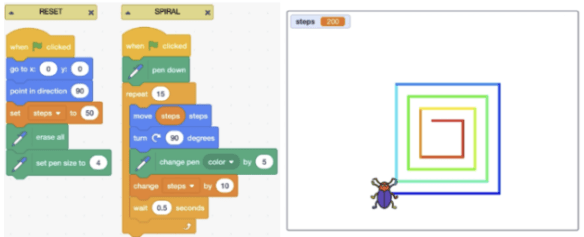
Real algebra is dynamic, not static.
It’s about expressing, exploring, and understanding how quantities co‑vary.
For example, in the pattern below, the number of blocks increases as the train car number changes. How many blocks are in the 10th car?

This pattern can be represented in a table.
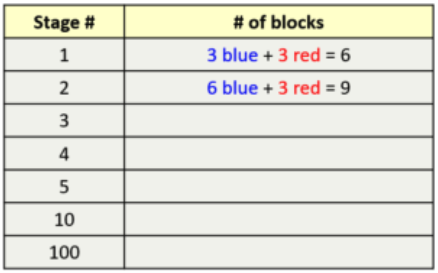
And as a bar graph.
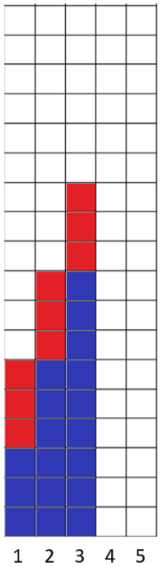
In Grade 9, patterns like this can be expressed using the linear equation
y = 3x + 3.
Growing patterns
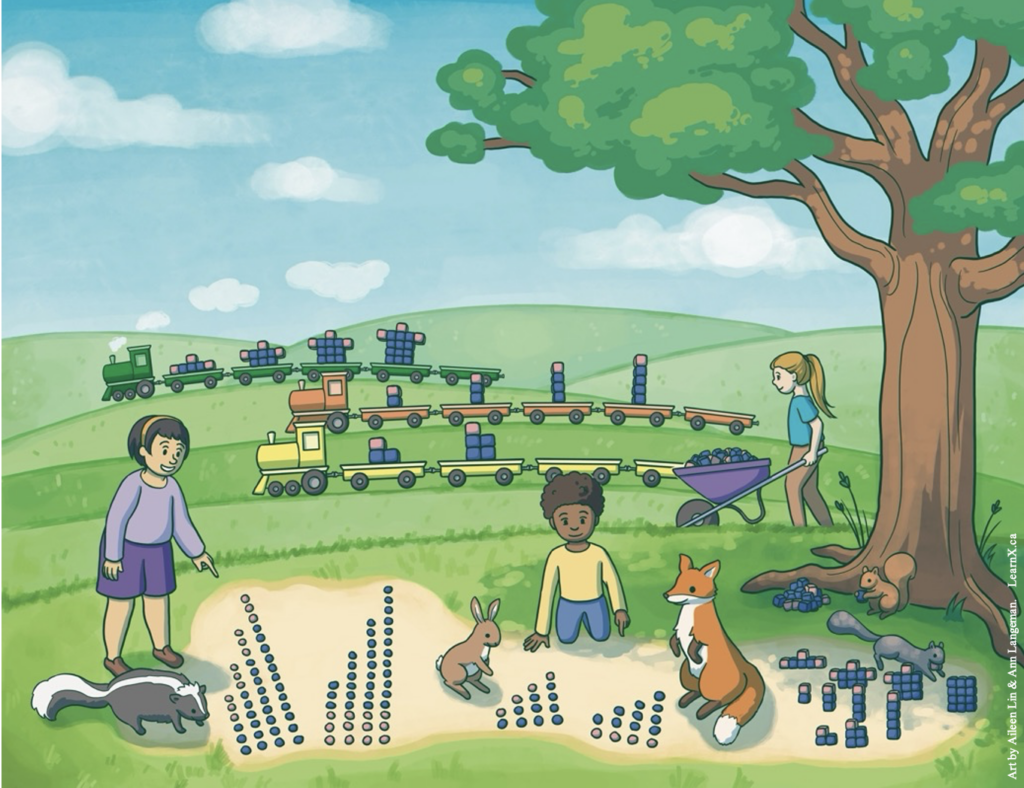
Take a look at the image below.
What do you notice? What is changing, and what stays the same as the patterns grow?
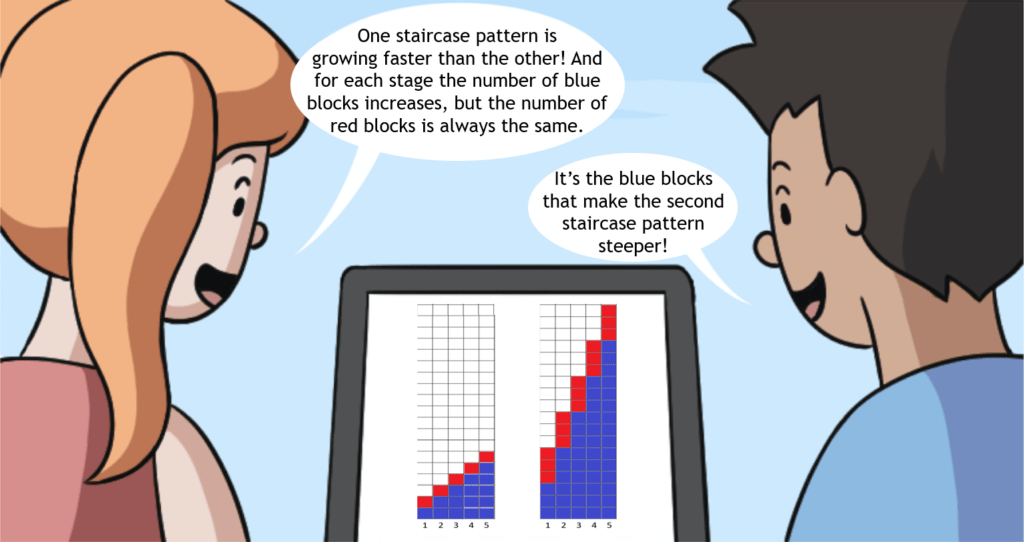
Comparing growing patterns
Explain the ways these three growing patterns are alike and how they differ from one another.
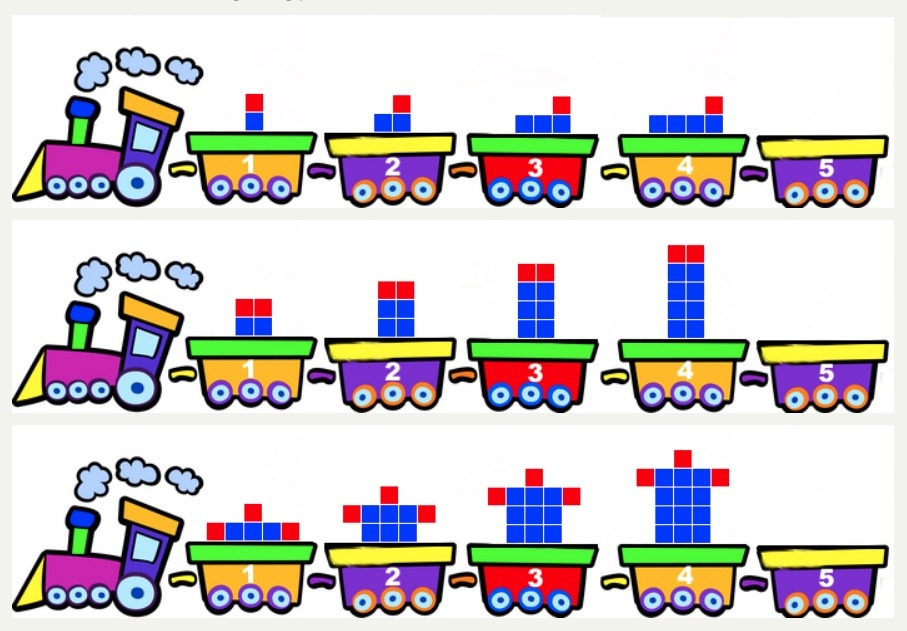
- How do the blue numbers/blocks change in each pattern?
- How do the red numbers/blocks change in each pattern?
Representing growing patterns
Represent each pattern in three ways:
- as a table of values
- as a bar graph
- as an equation
Growing patterns with Scratch
Run the code at https://scratch.mit.edu/projects/964727477/editor

This code represents this pattern.

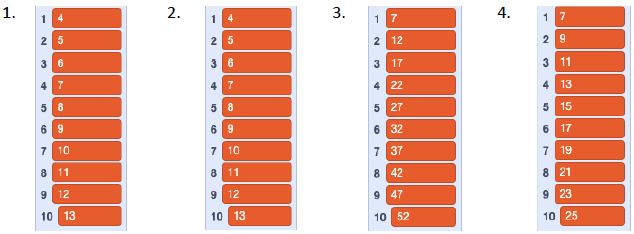
Edit the code to create each of the flowing lists of numbers. Run the code to test your predictions.
Growing patterns with Python
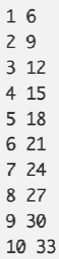
Go to https://cscircles.cemc.uwaterloo.ca/console .
- Enter and run the code below.
- You will see the list of numbers, as shown on the right.
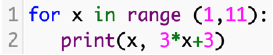
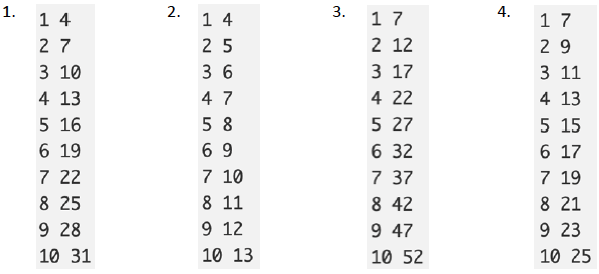
Edit the code to create each of the flowing lists of numbers. Run the code to test your predictions.
An interview with applied mathematician Dr. Lindi Wahl
See all interview clips with Dr. Lindi Wahl at https://imaginethis.ca/lindi-wahl
| Dr. Lindi Wahl discussing growing patterns. What changes and what stays the same? |
Growing patterns in a song
Listen to a song from Grades 1-2 classrooms.
| A little Easy and a little hard. Song from Grades 1-2 classrooms. Performed at a concert funded by the Fields Institute, KNAER and SSHRC. |