“I know numbers are beautiful. If they aren’t beautiful, nothing is.”
― Paul Erdős
Sets of numbers
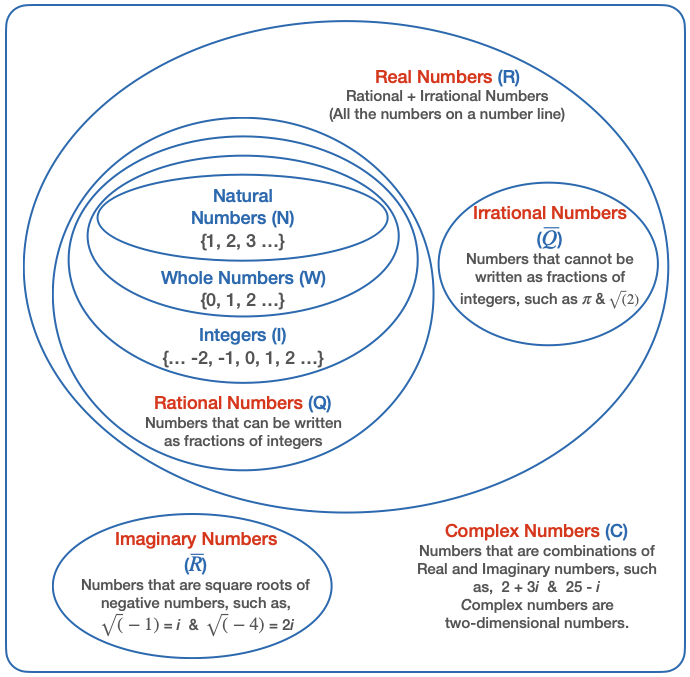
Here is bird’s-eye-view of sets and subsets of numbers.
The story of numbers is much longer—and stranger—than it first appears.
The numbers we now take for granted did not arrive all at once. They appeared slowly, often with resistance, as if each new kind of number had to fight for its right to exist.
Take negative numbers.
In the 7th century, the Indian mathematician Brahmagupta boldly wrote rules for adding and subtracting them—an idea far ahead of its time. Yet for more than a thousand years afterward, many mathematicians refused to accept numbers “less than nothing.” To them, negatives were shadows, tricks, or bookkeeping fictions—not real mathematics.
Long before that, over 2,500 years ago, the ancient Greeks stumbled onto lengths that could not be written as fractions—like the diagonals of some square. These strange quantities later came to be called irrational numbers. The Greeks could measure them as geometric lengths, but the idea of irrational numbers remained unsettling for centuries.
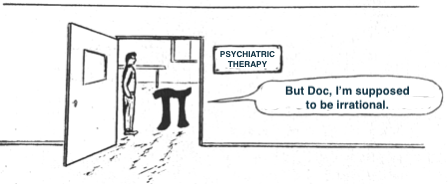
It wasn’t until the 19th century that irrational numbers were finally given precise definitions.
And what about zero? Well, let’s sing this song.
| ZERO. Written and performed by Lindi Wahl, Sara Wahl, Sue Wahl, and Michelle Wahl Craig. |
Today, we group these familiar characters together:
- Real numbers: every point on the number line.
- Rational numbers: real numbers that can be written as fractions.
- Irrational numbers: real numbers that cannot be written as fractions.
So far, so good.
But the story gets stranger.
When mathematicians tried to take the square root of a negative number, they reached a dead end—until the idea of imaginary numbers emerged. At first, people thought the name was a warning label: beware, these are not real.
Then, in 1797, a Danish–Norwegian surveyor named Caspar Wessel made an extraordinary proposal: imaginary numbers weren’t mistakes—they lived in a different dimension. If real numbers lay on a horizontal line, imaginary numbers stretched vertically, forming a second axis.
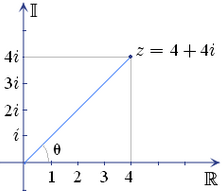
With this insight, a new world opened.
A number like 4 + 4i was no longer nonsense—it was a complex number, a point in a two‑dimensional plane, or even a vector with magnitude and direction. Complex numbers blended the real and imaginary into a unified whole.
And so the real number line became a complex plane.
Hmm. What about infinity?
That’s another story!