“I believe that we do not know anything for certain, but everything probably.”
―Christiaan Huygens
Binary choice
What do you see in the image below? What conceptual connections can you make?

TOSSING 1 COIN
Imagine doing this:
- Flip a coin.
- If it’s Heads, take one step along the red path.
- If it’s Tails, take one step along the yellow path.

Which result will more likely? A or B?
If you did this experiment several times and kept a tally, it might look like this.
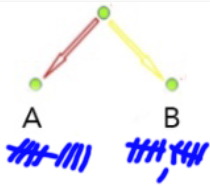
The 2 outcomes are equally likely.
TOSSING 2 COINS
Imagine doing this:
- Flip a coin.
- If it’s Heads, take one step along the red path.
- If it’s Tails, take one step along the yellow path.
- Flip the coin a second time.
- If it’s Heads, take one step along the red path.
- If it’s Tails, take one step along the yellow path.
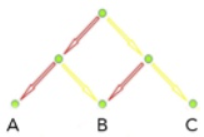
Which result is more likely—A, B, or C?
Most young children (Grades 1–2) initially believe all three outcomes are equally likely.
When they carry out the experiment, they are surprised to discover that B occurs twice as often.
Interestingly, some children can already explain why: they notice that there are two paths leading to B, but only one path each leading to A and to C.
This simple paths diagram provides children (and adults) with a powerful cognitive scaffold—offering clarity, reducing complexity, and supporting the development of deeper conceptual understanding.
TOSSING A COIN 5 TIMES
Now imagine flipping a coin 5 times and travelling left of right based on Heads or Tails.

Which result will more likely? A, B, C, D, E or F?
- Which letters are more likely to win?
- Which letters are more likely to lose?
- Why?
PASCAL’S TRIANGLE
How do the paths patterns connect to Pascal’s triangle?
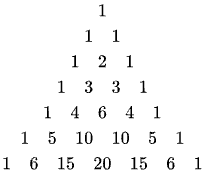
Did you know that this pattern was well known in China, several centuries before Pascal?
It was know was Yang Hui’s triangle.
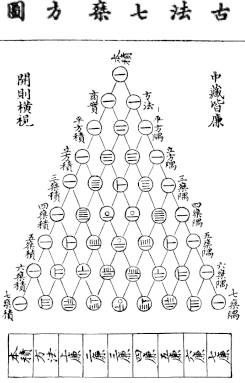
CONNECTIONS ACROSS REPRESENTATIONS
What connections do you notice?

BINARY CHOICE

When you toss a coin, you’re making a binary choice—a choice between just two options: heads or tails.
A light switch works the same way. It offers a simple binary state: on or off.
The idea of binary choice is remarkably powerful.
It appears in probability (coin tossing), in algebra (expressions like x + y that represent two possibilities), and in the binomial theorem, which beautifully links probability with algebra by showing how multiple binary events combine and expand.
Digital devices, like smartphones and computers, rely on countless combinations of these binary states. Their internal circuits operate using 1 (on) and 0 (off), making the binary number system perfectly suited to how they process information.

STATISTICIAN INTERVIEW
Interview with statistician Dr. Bethany White (University of Toronto).
| Dr. Bethany White discusses the possible outcomes when flipping 5 coins. |